
QUICK ANSWER
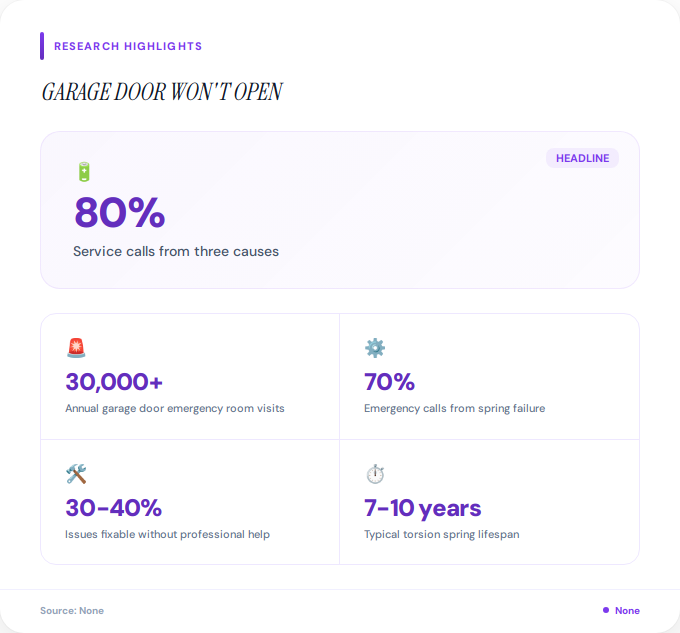
A garage door that won’t open is most often caused by dead remote batteries, a broken torsion spring, or a misaligned safety sensor, three issues that together account for roughly 80% of all service calls. Check batteries and sensors first since those are safe DIY fixes, but if the door feels too heavy to lift manually, stop immediately and call a professional because that signals a dangerous spring failure.
Table of Contents
- Why Won’t My Garage Door Open?
- What Are the Most Common Causes?
- Which Fixes Are Safe to Try Yourself?
- Why Are Broken Springs So Dangerous?
- How Does Weather Affect Garage Doors?
- How Much Does Repair Cost?
- When Should You Call a Professional?
- People Also Ask
- Frequently Asked Questions
It’s 6:45 a.m., you’re already running late, and your garage door won’t open. You’re not alone: garage door malfunctions contribute to more than 30,000 emergency room visits annually, a number that’s climbing as more homeowners attempt risky DIY repairs in a high-inflation economy. Before you panic or grab a wrench, it helps to know that most “garage door won’t open” situations trace back to one of just a handful of predictable problems, some of which take two minutes to fix, and others that demand you step away entirely.
Why Won’t My Garage Door Open?
The overwhelming majority of stuck garage doors fall into three categories: dead remote batteries, a broken torsion spring, or a misaligned safety sensor. Dead batteries are the single most frequent culprit reported by homeowners, but when it comes to emergency service calls specifically, spring failure dominates the numbers.
According to the International Association of Garage Door Dealers, spring failures now account for an estimated 70% of emergency calls in 2026, a trend industry analysts link to aging housing stock and deferred maintenance. Meanwhile, other diagnostic data breaks failures down more granularly across springs, sensors, and drive components.
What Are the Most Common Causes?
Roughly 80% of all “door won’t open” service calls come down to three root causes. Understanding the breakdown helps you diagnose your own situation before calling anyone.
| Cause | Share of Calls | Typical Sign |
|---|---|---|
| Broken torsion spring | ~40-70% | Loud bang, door feels extremely heavy |
| Misaligned/dirty photo-eye sensors | ~25% | Opener hums but door won’t move, blinking light |
| Worn drive gears or failed logic board | ~15% | Motor runs but door doesn’t budge |
Some industry technicians go even further, noting that safety sensor misalignment is behind roughly 9 out of 10 non-response issues they encounter on service calls, particularly on doors that refuse to close rather than open. The exact split varies by source and region, but the pattern is consistent: sensors and springs are your two prime suspects.
Which Fixes Are Safe to Try Yourself?
Not every stuck door means an expensive repair. Safe, homeowner-friendly fixes resolve an estimated 30-40% of “no-open” complaints without any tools beyond a screwdriver and a soft cloth.
- Replace remote and wall-button batteries first, since this resolves the largest share of false alarms.
- Wipe down the photo-eye sensors near the bottom of the tracks; dust, cobwebs, or a stray box blocking the beam will halt operation instantly, per Chamberlain’s official troubleshooting guidance.
- Check the sensor LEDs. If one light is blinking or off, the sensors are misaligned and need gentle repositioning until both glow solid.
- Inspect the tracks for visible obstructions, bent rails, or debris buildup.
- Confirm the opener is receiving power, since a tripped breaker or unplugged unit is an easy, overlooked fix.
- Lubricate rollers and hinges if the door moves sluggishly rather than not at all.
For a visual walkthrough of these checks, this step-by-step troubleshooting video demonstrates exactly where to look on most residential opener models.
Why Are Broken Springs So Dangerous?
Torsion springs typically last 7 to 10 years before fatigue sets in, and when they go, they go suddenly, often with a bang loud enough to be mistaken for a gunshot. These springs hold enormous tension because they’re doing the work of lifting a door that can weigh 150 to 400+ pounds.
“If you pull the emergency release cord and the door is too heavy to lift by hand, stop right there. That’s not a job for a screwdriver and a Saturday afternoon, that’s a spring problem, and it needs a trained technician with the right tools.”
This is exactly why experts uniformly warn homeowners to never attempt work on torsion springs, extension springs, lift cables, or bottom brackets. These parts store enough energy to cause serious injury, which helps explain the tens of thousands of ER visits tied to garage door mishaps each year. If you want to understand the mechanics further, this breakdown of common garage door failures walks through why spring tension is uniquely hazardous compared to other repairs.
How Does Weather Affect Garage Doors?
Weather is a bigger factor than most homeowners realize. An estimated 78% of garage door failures occur during extreme weather conditions, whether that’s a hard freeze seizing up the tracks or coastal humidity accelerating rust on hardware.
Cold Climates
Peak failures during: freeze-thaw cycle. Common issue: stiffened lubricant, contracted metal
Coastal Regions
Primary risk: accelerated corrosion Affected parts: springs, hinges, tracks
All Regions
Weather-linked failures: 78%
Preventable with: seasonal maintenance
Despite how preventable weather-related wear can be, fewer than 15% of homeowners schedule annual inspections. A comprehensive troubleshooting guide notes that regular lubrication and hardware checks are the single most effective way to avoid an emergency lockout, especially heading into winter or hurricane season.
How Much Does Garage Door Repair Cost?
Pricing for garage door repairs varies widely depending on the cause, the age and weight of your door, the parts required, and your local market. Emergency repairs in 2026 typically range from $150 to $700 or more, and spring replacements alone can run into several hundred dollars depending on spring type, door size, and whether both springs need replacing at once.
Because springs work as a matched pair and wear at a similar rate, many technicians recommend replacing both even if only one has failed, which affects total project cost. Rather than fixating on a single number, it’s more useful to think of pricing as dependent on scope, materials, and the complexity of your specific system. If your situation involves a full opener replacement or structural track damage, costs can climb further, so getting a custom quote based on an in-person inspection is always the most accurate path forward.
When Should You Call a Professional?
Some situations are worth attempting yourself, and others are not. Here’s how to tell the difference quickly.
- Call immediately if: the door won’t budge even manually, you heard a loud bang before it stopped working, cables look frayed or snapped, or the door is crooked in its tracks.
- Try it yourself first if: the remote isn’t responding, the sensor lights are blinking, or the opener runs but the door doesn’t move smoothly.
- Emergency repair is warranted if: you have only one working vehicle bay, a security concern, or the door is stuck fully open overnight.
Emergency repair demand has grown enough that dedicated same-day and after-hours repair services have become standard offerings in most metro markets, reflecting just how disruptive a non-functioning door is to daily life.
- Key Takeaways
- Dead remote batteries and misaligned sensors cause the majority of “easy fix” situations, resolving 30-40% of complaints without a technician.
- Broken torsion springs are responsible for an estimated 40-70% of service calls and account for the loud bang many homeowners report hearing.
- Torsion springs have a 7-10 year lifespan, so age is a strong predictor of failure risk.
- Never attempt DIY repair on springs, cables, or bottom brackets, these store dangerous tension and are linked to over 30,000 ER visits a year.
- 78% of failures are weather-related, yet fewer than 15% of homeowners schedule annual maintenance to prevent them.
- If the door won’t lift by hand during a manual test, it’s a spring issue requiring a professional, not a DIY project.
People Also Ask
A sudden stop is most often caused by a broken torsion spring, especially if you heard a loud bang beforehand, or simply dead remote batteries. Test the wall button first; if that also fails to move the door, suspect a mechanical issue rather than a remote problem.
A humming motor with no movement usually points to a broken spring, a disengaged trolley, or a stripped drive gear. Since the motor is receiving power but can’t generate lift, this is not a battery or sensor issue and typically requires professional inspection.
Yes, most doors have a manual release cord (usually red) that disconnects the trolley from the opener. However, if the door feels unusually heavy or won’t lift smoothly by hand, that indicates a spring failure and you should not force it.
Basic tasks like replacing batteries, cleaning sensors, and lubricating rollers are generally safe for homeowners. Spring, cable, and bottom bracket repairs are not, since these components are under extreme tension and are linked to thousands of injuries annually.
Frequently Asked Questions
Start with the remote batteries, then check whether the photo-eye sensors near the floor are clean, aligned, and unobstructed. These two checks resolve the majority of simple no-open complaints.
Look for a visible gap in the spring above the door, and recall whether you heard a loud bang recently. If the door feels extremely heavy when lifted manually, that confirms a spring failure.
Costs typically range from $150 to $700 or more depending on the cause, with spring replacement often costing several hundred dollars. Pricing varies based on door size, spring type, and regional labor rates, so a custom quote is the most reliable way to know your actual cost.
Yes, roughly 78% of garage door failures occur during extreme weather, and cold-climate regions see spikes during freeze-thaw cycles as metal contracts and lubricant stiffens. Regular seasonal maintenance significantly reduces this risk.
This is frequently a sensor alignment issue or a limit-setting problem on the opener itself. Track obstructions and worn rollers can also cause the door to stall partway through its cycle.
Yes, continuing to operate a door with a failing spring, frayed cable, or misaligned track increases the risk of sudden collapse or injury. Garage door incidents contribute to over 30,000 ER visits annually, so it’s safer to stop use and call a professional at the first sign of trouble.
An annual inspection is recommended, yet fewer than 15% of homeowners currently schedule one. Given that springs wear out after 7 to 10 years and weather drives most failures, yearly checkups are the most effective way to prevent emergencies.
A garage door won’t open situation rarely comes with a warning, but it almost always comes with a solvable cause. Whether it’s a five-minute battery swap or a spring that’s reached the end of its 7 to 10 year lifespan, knowing the difference protects both your schedule and your safety. If your troubleshooting points to anything spring-related, cable-related, or structural, don’t risk it, reach out to a licensed garage door professional for an inspection and a custom quote tailored to your specific door and situation.