
| Quick Answer: Minnesota summers swing from humid, sticky afternoons to bright, dry heat, and both extremes put stress on a garage door. Heat can make metal panels expand and throw off sensor alignment, while humidity can swell wood composite panels and make weatherstripping stick or tear. If your door has been sluggish, noisy, or hard to close fully this summer in Saint Louis Park or Richfield, the cause is often seasonal rather than a sign the door is failing. Sam’s Garage Door and Home Services offers free estimates to diagnose and fix these issues. Call (952) 234-9090. |
Heat Changes the Shape of Your Door More Than You Think
Steel and aluminum garage door panels expand slightly as temperatures climb, and on a hot, sun facing garage door that can be a meaningful amount of movement across a large panel. That expansion can be enough to throw off the alignment of the photo eye safety sensors near the bottom of the track, which is one of the most common reasons a garage door will not close all the way in July and August. The fix is often as simple as re-aligning the sensors, but repeated heat cycles over several summers can also loosen brackets that need to be re-tightened.
Humidity Affects Wood and Composite Panels
Homes in Saint Louis Park and Richfield with wood or wood composite garage doors will notice the door getting harder to open or close on the most humid days of summer. Humidity causes these materials to absorb moisture and swell slightly, which can make the door bind against the frame or weatherstripping. Steel doors are less affected by humidity directly, but the rubber weatherstripping around any door type can soften, stick, or degrade faster in a hot, humid Minnesota summer.
Your Garage Temperature Affects Your Energy Bill
An attached garage that shares a wall with living space acts like a buffer zone. In summer, an uninsulated garage door lets that buffer zone get hot fast, which pushes heat into the attached wall and can make your air conditioner work harder. This is one of the more overlooked home efficiency issues in older Twin Cities homes, since homeowners tend to focus on attic and window insulation first.
Garage Door Insulation: Typical R-Value by Construction
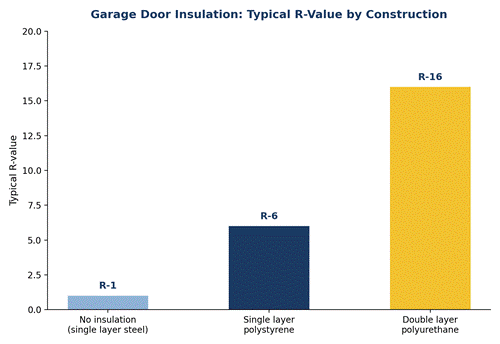
General industry reference ranges for common garage door constructions.
| Construction type | Typical R-value | Best for |
| No insulation, single layer steel | R-1 or less | Detached garages with no living space nearby |
| Single layer with polystyrene | R-6 | Attached garages in moderate climates |
| Double layer with polyurethane | R-12 to R-18 | Attached garages in Minnesota’s climate, especially near living space |
Summer Garage Door Maintenance Table
| Issue | Likely cause | What to do |
| Door will not close all the way | Heat has shifted the photo eye sensor alignment | Clean and re-align the sensors, or call for service if it persists |
| Door feels heavy or sticks partway | Humidity swelling in wood or composite panels, or worn weatherstripping | Replace weatherstripping and check panel fit |
| Opener motor seems to strain more in summer | Heat affects lubricant viscosity on tracks and rollers | Apply a silicone based lubricant made for garage doors |
| Garage feels hot and affects an adjoining room | Little to no insulation in the door | Ask about an insulated door upgrade or retrofit insulation kit |
| Noisy operation on hot afternoons | Metal expansion changing roller and track tolerances | Have a technician check roller wear and track spacing |
Frequently Asked Questions
Why does my garage door only act up in the summer?
Heat and humidity both change the physical dimensions of garage door materials and hardware slightly, which is enough to affect sensor alignment, panel fit, and lubrication. It is a seasonal pattern rather than random failure.
Will an insulated garage door actually lower my cooling costs?
It can, particularly if your garage shares a wall with living space or sits below a bedroom. The savings depend on your home’s layout, but an insulated door reduces heat transfer into the attached structure.
How often should I lubricate my garage door in summer?
Most homeowners in Saint Louis Park and Richfield do well with a light silicone based lubricant on rollers, hinges, and the track every three to six months, with a check in early summer when heat cycling begins.
Can I re-align the photo eye sensors myself?
Many homeowners can do this safely by gently adjusting the sensor brackets until the indicator lights on both sensors align. If the door still will not close after that, it is worth having a technician take a look.
Is it worth upgrading to an insulated door just for summer comfort?
If your garage sits under or beside living space, yes, it is one of the more cost effective comfort upgrades available. If it is a detached garage with no shared walls, the payoff is smaller.
| Sam’s Garage Door and Home Services Serving Minneapolis, Saint Louis Park, Eden Prairie, and Richfield Call (952) 234-9090 | samgarageservices.com |